
When Socialism Works
Chile, 1973
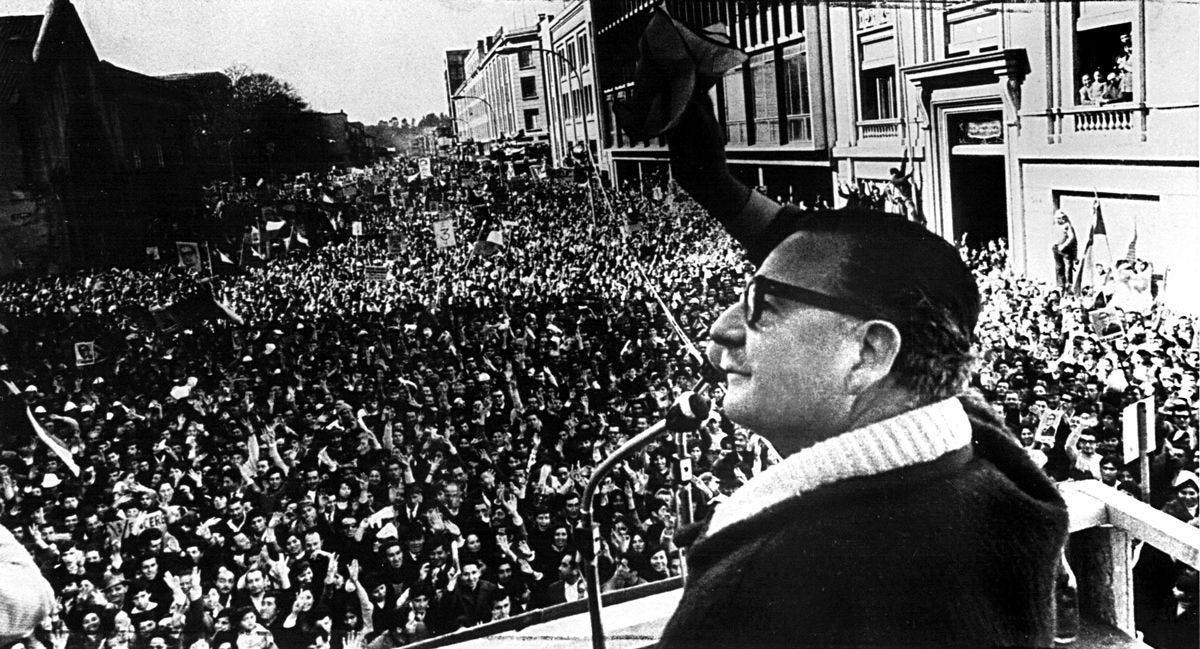
Mark Fisher described capitalist realism as “the fatalistic acquiescence in the view that there is no alternative to capitalism.” In one of his last pieces of writing, he pointed to Chile: “If there was a founding event of capitalist realism, it would be the violent destruction of the Allende government in Chile by General Pinochet’s American-backed coup.” (Acid Communism, unfinished introduction, 2016).
That framing makes Allende’s government worth revisiting in at least two ways. First, as a source of ideas — what an alternative (to Stalinism as well as capitalism) actually looked like when it was being built, in concrete institutional detail, by real people working within real constraints. And second, as a window into how power responds when such an alternative starts working: what coordination between state and capital looks like in practice, and what that tells us about what any serious challenge to the current arrangement can expect to encounter.
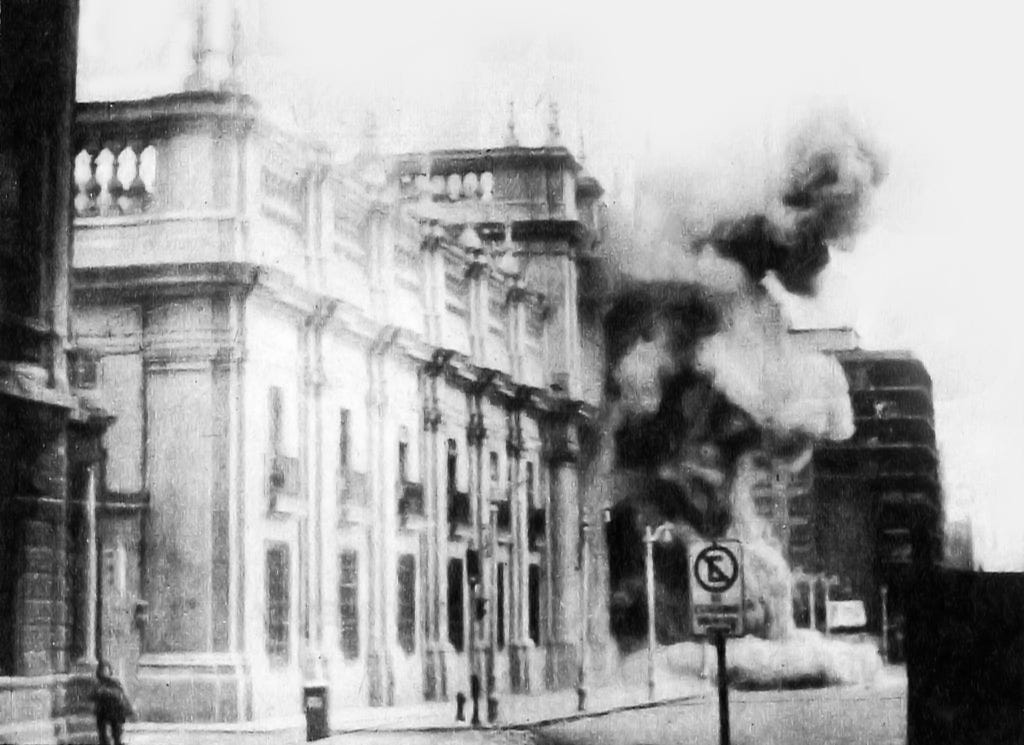
On September 11th, 1973, the US-backed Chilean military bombed the presidential palace in Santiago.
The elected president died inside. The junta that replaced him disappeared thousands, imprisoned and tortured tens of thousands more, and completely restructured Chile’s economy.1
To understand why, you have to know what they were destroying.
Three years earlier, Chile had done something no country had ever done. They democratically elected a Marxist president.2
Salvador Allende’s platform was sweeping: nationalize the copper mines — Chile’s primary resource, owned almost entirely by American corporations — nationalize the banks, expand healthcare, housing, education. The vote to nationalize copper passed unanimously in Congress. Including the opposition.
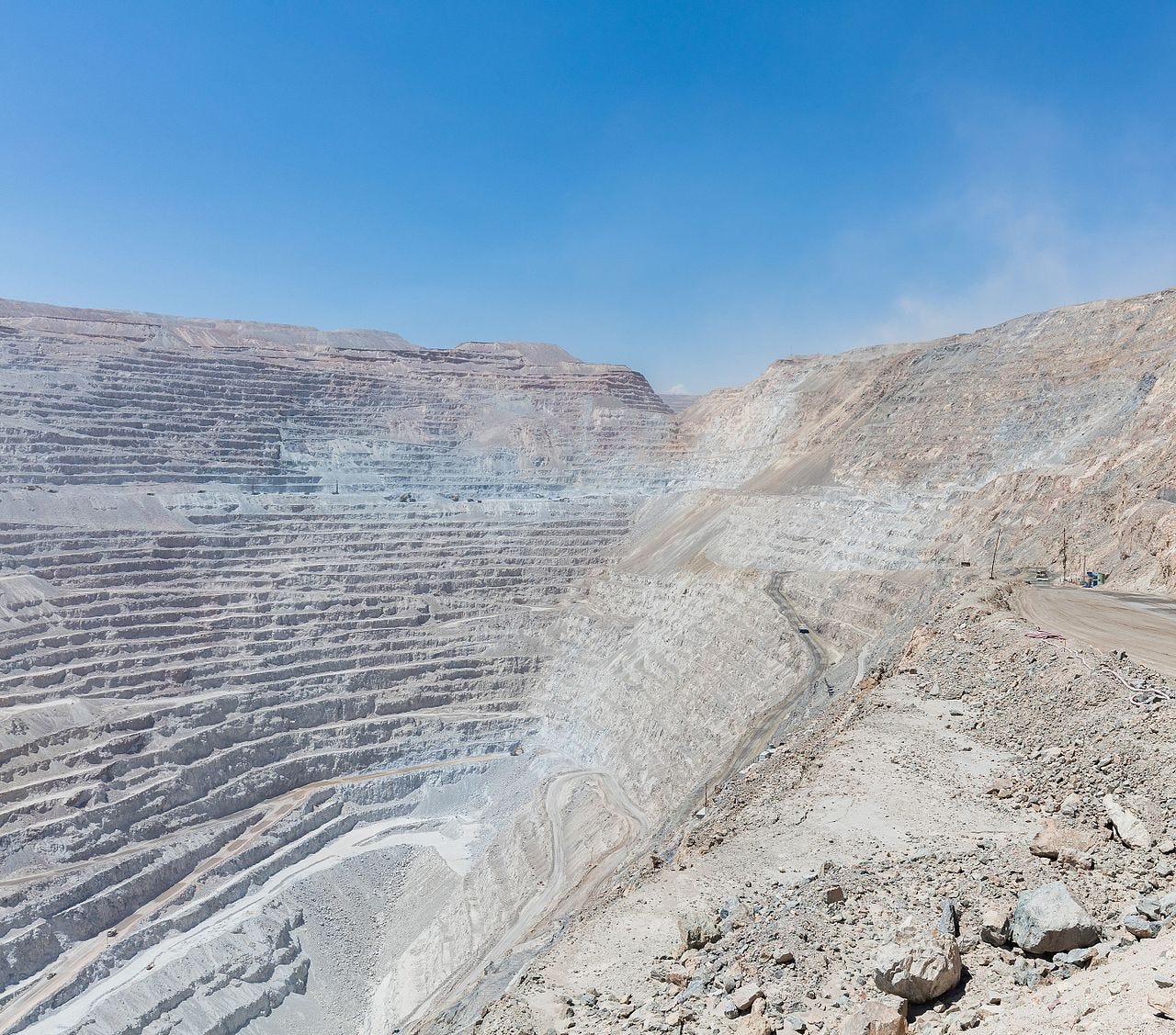
His government launched free milk for every child in the country. Copper revenues that had been leaving the country started funding schools and hospitals instead.
They reinvented economic planning, building a nationwide communications network connecting factories to a central operations room in real time — not Soviet-style central planning, which had failed by trying to control everything from the top down, but a distributed system where decisions stayed local unless they needed to escalate.3

Poverty fell. Wages rose. The economy was being shaped to serve people rather than extract from them.
It lasted three years.
The architects of the coup handed the economy to a group of American-trained economists who privatized public services, eliminated price controls, crushed unions, and slashed social spending — what’s become known as neoliberalism, imposed here for the first time under cover of a terror campaign against anyone who might oppose it — labor organizers, intellectuals, artists, political leaders.
Declassified documents show years of coordinated effort between American corporations, the CIA, and the White House to destabilize and bring down Allende’s government — the coup a last resort when everything else had failed.4
What Chileans had built together was democratic, legal, replicable within most existing liberal democracies. No violent overthrow. No seizure of power. Just a majority of people, organized, using the tools available to them.5
So the question Chile leaves open — the one nobody has fully answered yet — is not whether there is any viable alternative to capitalism.
It’s how you build it in a way that can’t be destroyed by the few people for whom it’s a problem.
How much of this translates to contemporary American politics specifically is not a simple question. Chile’s constitutional order in 1970 was more permeable to this kind of politics than the US is today — it had genuine multi-party competition, no counter-majoritarian Senate, no Supreme Court with a history of striking down redistributive legislation.
There is also the question of how to interpret the coup. On one reading, the fact that Allende had to be murdered — that his program couldn’t be stopped through normal political channels — is evidence that constitutional democratic socialism is more viable than its critics allow. On another, it suggests that capital will simply move outside constitutional channels when sufficiently threatened, rendering the question of institutional permeability somewhat beside the point.
Whatever strategic conclusions you draw from the coup itself or the specific circumstances that made Chile’s constitutional order more permeable than most, the history establishes something more fundamental: that a genuine alternative was built, that it commanded real democratic majorities, and that it had to be actively destroyed rather than simply failing on its own terms. The strategic questions are hard and open. The existence of the horizon isn’t.
These figures come from Chile's own truth commissions — the Rettig Commission (1991) and the Valech Commission (2004) — which documented at least 3,216 killed or disappeared and approximately 28,000-40,000 survivors of political imprisonment and torture, with the official total of all categories of victim recognized by the Chilean government standing at over 40,000. The figures are almost certainly undercounts; the Valech Commission's establishing principles kept the identities of perpetrators secret for fifty years, and researchers have noted that cases of torture were in some instances deliberately omitted from the final record. Additionally, an estimated 200,000 Chileans were forced into exile.
More precisely, Allende was the first avowed Marxist to win executive power through competitive, multi-party elections in a substantial nation-state. San Marino had communist-led coalition governments briefly in the 1940s, but San Marino is a city-state of tens of thousands. The major postwar European socialist governments — Attlee's Labour in the UK, the Scandinavian social democrats — were explicitly non-Marxist in their theoretical commitments, having abandoned revolutionary politics for Fabian gradualism or social liberalism. Allende's Socialist Party described itself as Marxist-Leninist; Allende consistently identified as a Marxist; and Popular Unity included the Chilean Communist Party as a core coalition partner. Marxist governments had existed before, of course, but they had come to power through revolution or Soviet imposition, not the ballot box.
The system was called Project Cybersyn (or Synco in Spanish). Its physical backbone was Chile’s existing telex network — machines already present in factories nationwide that could transmit text in real time — repurposed into a two-way communications infrastructure linking the shop floor to a central operations room in Santiago. Factories sent daily production data upward; the operations room could send instructions back. The conceptual architecture, designed by British cyberneticist Stafford Beer, was what made it genuinely novel: rather than centralizing all decision-making in Santiago, the system was built on a principle of subsidiarity — decisions stayed local unless they exceeded local capacity and needed to escalate. This was a direct departure from Soviet-style central planning, which required the center to micromanage everything and produced the informational bottlenecks that plagued those economies. Cybersyn was stress-tested in October 1972 when a CIA-backed truckers’ strike attempted to strangle the economy; using the network to coordinate still-operating trucks, the government kept supply chains running. The system was destroyed after the coup. It’s worth noting: Cybersyn represented just over fifty years of technological and theoretical development from the Soviet Union’s founding in 1917. We are now just over fifty years from Cybersyn itself — and the tools available for this kind of distributed economic coordination have advanced by orders of magnitude. Eden Medina’s Cybernetic Revolutionaries (MIT Press, 2011) is the definitive account. For the broader theoretical tradition of computer-assisted socialist planning, see Cockshott and Cottrell’s Towards a New Socialism (1993), available free online.
The coup on September 11, 1973 was the culmination of three years of coordinated economic and political sabotage. Declassified documents show Nixon authorized $10 million for CIA covert operations in Chile as early as 1970 — before Allende had even been inaugurated — with the CIA director’s handwritten notes recording the presidential instruction to “make the economy scream.” Operations included funding opposition media, bankrolling the 1972 truckers’ strike that Cybersyn helped defeat, and direct coordination between the CIA and US corporations with Chilean holdings, including ITT, which had significant interests in Chilean telecommunications. When these efforts failed to dislodge Allende, the military coup became the chosen instrument. Peter Kornbluh’s The Pinochet File (2003) is the most comprehensive account drawn from declassified documents.
Popular Unity was not a monolith, and the relationship between Allende's government and the Chilean working class was one of productive tension as much as alignment. Workers in many industries — as documented in Peter Winn's Weavers of Revolution (1986), a ground-level account of the Yarur textile workers — were pushing for faster and more thoroughgoing transformation than the government's gradualist constitutional strategy allowed for. Factory occupations and worker self-management initiatives frequently outpaced official policy. Allende's government spent considerable energy managing this pressure from below, trying to hold together a coalition between revolutionary ambition and constitutional legitimacy. This tension was never resolved — the coup foreclosed it. But it's worth noting that the radicalism didn't flow only from the top down.